Business emailGuide
ProtonMail Review: Free, Mail Plus or Business, and What Stays Encrypted
ProtonMail review from Proton's own pages: Free vs Mail Plus vs business plan limits, what its encryption covers, and when Fastmail or Tuta fits better.
Disclosure: we may earn a commission if you buy through links on this page. It costs you nothing extra and never decides a verdict or an EDGE mark. How we make money.

Verdict
Verdict
Proton Mail is worth paying for if you want stored mail that Proton says it cannot read: Mail Plus is billed $29.88 for the first 12 months and renews at $47.88 a year1, and inbox contents use zero-access encryption4. Subject lines are not end-to-end encrypted4, so if you want those covered too, or a cheaper business seat with a larger mailbox, look at Tuta or Fastmail108.
At a glance
At a glance
| # | Tool | Best for | Starting price | Link |
|---|---|---|---|---|
| 01 | Proton Mail | People and small teams who want mail the provider says it cannot read, with Swiss jurisdiction and a free tier to start on | Free; Mail Plus $29.88 for the first 12 months, then $47.88 a yearchecked 2026-11-24 | Visit (opens in a new tab) |
| 02 | Fastmail | Teams that want a large, fast standard mailbox on their own domain and accept that the provider holds the keys | $5/user/mo billed yearly (Standard)checked 2026-11-24 | Visit (opens in a new tab) |
| 03 | Tuta | Readers who want subject lines, calendars and contacts end-to-end encrypted as well as message bodies | Free plan (1 GB); paid prices not shown on the page we readchecked 2026-11-24 | Visit (opens in a new tab) |
Prices are the lowest paid starting price on each vendor's public pricing page on the date shown, in US dollars, before tax. Confirm on the vendor's site before you buy.
This ProtonMail review is built from Proton’s own pricing, security and support pages, all read on 2026-11-24, with Fastmail and Tuta as reference points from their own sites. We did not run a hands-on test. Proton Mail is a Swiss email service that stores your inbox with zero-access encryption45. The questions most readers bring are which plan to buy, what the free tier leaves out, and what Proton can and can’t see. Our method is on the how we compare page.
ProtonMail review in brief
Buy Proton Mail if the main thing you want from a mailbox is that the company storing it can’t read it. Proton says inbox messages and attachments use zero-access encryption and that nobody else can access them, including Proton itself4. Mail between two Proton accounts is end-to-end encrypted in transit as well4.
The free plan is fine for a private personal address. It runs out quickly as a main inbox: 1 GB at most, 150 messages a day, and 3 folders1. Most people who stay will end up on Mail Plus for a custom domain and unlimited organizing.
Look elsewhere if you need subject lines encrypted (Proton leaves them outside end-to-end encryption4) or if a big business mailbox at a low seat price matters more to you than provider-blind storage. If you are weighing it against Google specifically, our ProtonMail vs Gmail comparison covers that switch.
Proton Mail plans and prices
Proton’s consumer pricing page shows three tiers in US dollars, with a 50% discount on the first 12 months of the paid plans1:
| Plan | First 12 months | Renewal | Storage | Addresses | Custom domains |
|---|---|---|---|---|---|
| Free | $0 | $0 | Up to 1 GB | 1 | None |
| Mail Plus | $29.88 ($2.49/mo) | $47.88 every 12 months | 15 GB | 10 | 1 |
| Proton Unlimited | $77.88 ($6.49/mo) | $119.88 every 12 months | 500 GB | 15 | 3 |
Source: Proton Mail pricing1.
The monthly list prices on the same page are $4.99 for Mail Plus and $12.99 for Proton Unlimited1. Budget for the renewal figure rather than the first-year one: Mail Plus goes from $29.88 to $47.88 in year two, and Unlimited from $77.88 to $119.881. The page offers a 30-day money-back guarantee1.
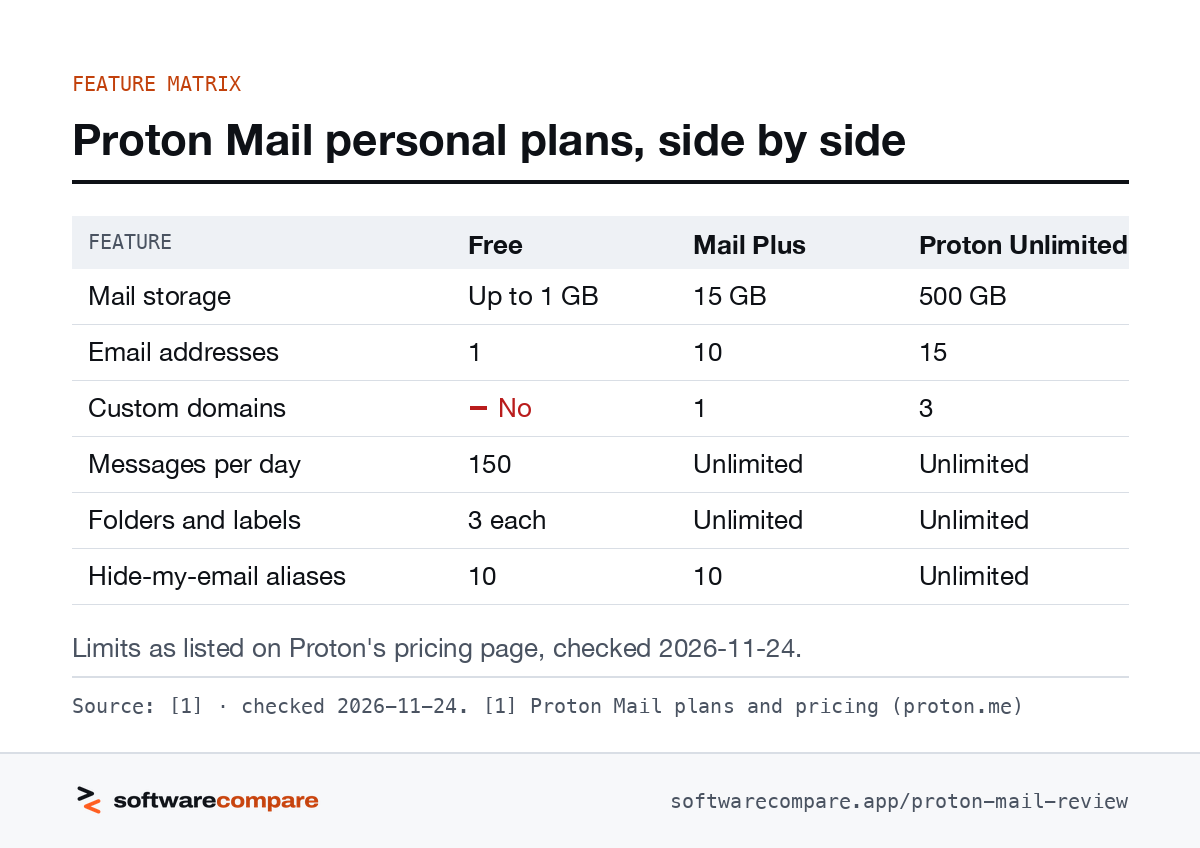
Proton Unlimited makes sense when 15 GB is too small. It jumps to 500 GB, adds two more custom domains and lifts the hide-my-email alias cap from 10 to unlimited1. If encrypted file storage is part of the plan, our Tresorit review sets Proton Drive against Tresorit.
| Feature | Free | Mail Plus | Proton Unlimited |
|---|---|---|---|
| Mail storage | Up to 1 GB | 15 GB | 500 GB |
| Email addresses | 1 | 10 | 15 |
| Custom domains | No | 1 | 3 |
| Messages per day | 150 | Unlimited | Unlimited |
| Folders and labels | 3 each | Unlimited | Unlimited |
| Hide-my-email aliases | 10 | 10 | Unlimited |
Limits as listed on Proton’s pricing page, checked 2026-11-24.
Source: [1] · checked 2026-11-24Download image
Where the free plan runs out
Proton says it will always offer a free plan, paid for by subscribers1. The limits are tighter than most free webmail1:
- Storage. 500 MB at sign-up, raised to 1 GB when you finish the “Get started with Proton” checklist. One checklist task is setting up automatic forwarding from Gmail.
- Sending. 150 messages a day.
- Organizing. 3 folders, 3 labels and 1 custom filter.
- Addresses. One address, no custom domain, and no short @pm.me address.
- Calendars. 3 personal calendars, against 25 on Mail Plus and Unlimited.
- Desktop app. A 14-day trial on Free, included on paid plans.
The encryption features don’t change between tiers. End-to-end encryption, password-protected emails and encrypted contact details are listed as included on all three personal plans, and each has a 25 MB attachment limit1.
Business plans: Mail Essentials or Workspace
Proton’s business page lists three paid tiers, priced per user per month on yearly billing2:
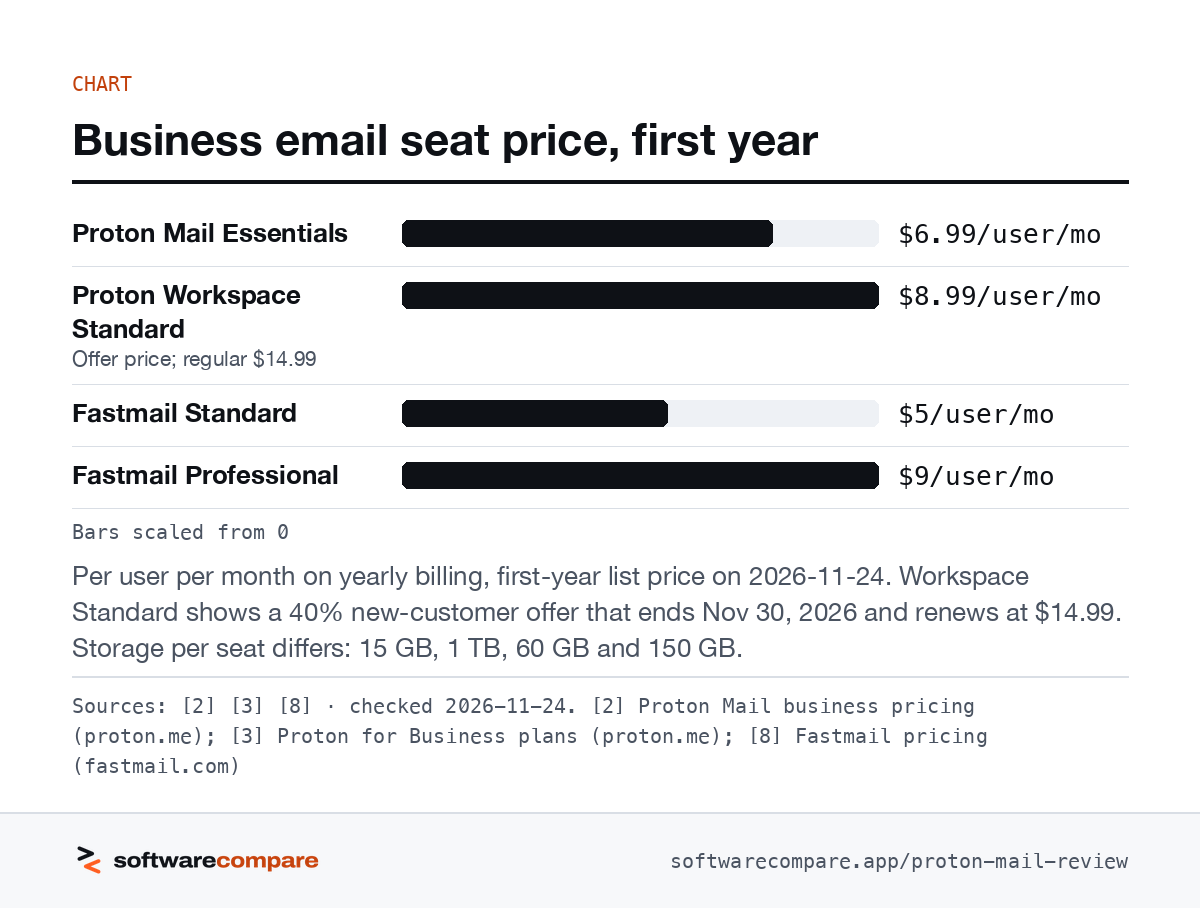
- Mail Essentials, $6.99 (billed $83.88 every 12 months): 15 GB per user, 10 addresses per user, 3 custom domains, calendar, appointment scheduling and migration tools.
- Workspace Standard, $8.99 in the first year (billed $107.88): 1 TB per user, 20 addresses per user, 15 custom domains, email groups, Proton Sentinel, video meetings for 100 people, a VPN and a password manager with team vaults.
- Workspace Premium, $14.99 in the first year (billed $179.88): 3 TB per user, 20 custom domains, meetings for 250 people, the Proton Scribe writing assistant and data retention policies.
Every business tier includes catch-all addresses, automatic forwarding, password-protected emails, unlimited filters, folders and labels, SMTP access for external tools, and support for Outlook, Thunderbird and Apple Mail2. Each one offers a 14-day free trial2.
The Workspace prices above are a promotion. Proton lists the regular rates as $14.99 for Standard and $24.99 for Premium per user per month3. The 40% offer is for new customers on 1-year plans, applies to up to 10 users (a plan that goes past 10 users pays the regular price for everyone), renews at the regular price, and ends on November 30, 2026 at 23:5923. A team that only needs mail and a calendar can start on Mail Essentials, which Proton describes as the plan for that case2.
Check the seat storage before you pick Mail Essentials: it stops at 15 GB per user2. Fastmail’s Standard business plan is $5 per user per month on yearly billing with 60 GB per user, and Professional is $9 with 150 GB8.
Bars scaled from 0
Per user per month on yearly billing, first-year list price on 2026-11-24. Workspace Standard shows a 40% new-customer offer that ends Nov 30, 2026 and renews at $14.99. Storage per seat differs: 15 GB, 1 TB, 60 GB and 150 GB.
Sources: [2] [3] [8] · checked 2026-11-24Download image
What Proton encrypts, and what it can still see
Proton’s support article spells out the model4:
- Messages and attachments in your inbox are stored with zero-access encryption, and that includes mail sent to you from other providers.
- Mail between Proton accounts is always end-to-end encrypted.
- Mail from Proton to Gmail, Outlook and other providers travels over TLS. Once it lands, it isn’t end-to-end encrypted by default, so the recipient’s provider may be able to read it.
- Mail arriving from other providers comes in over TLS and is then stored with zero-access encryption. The sender’s provider may still keep its own copy.
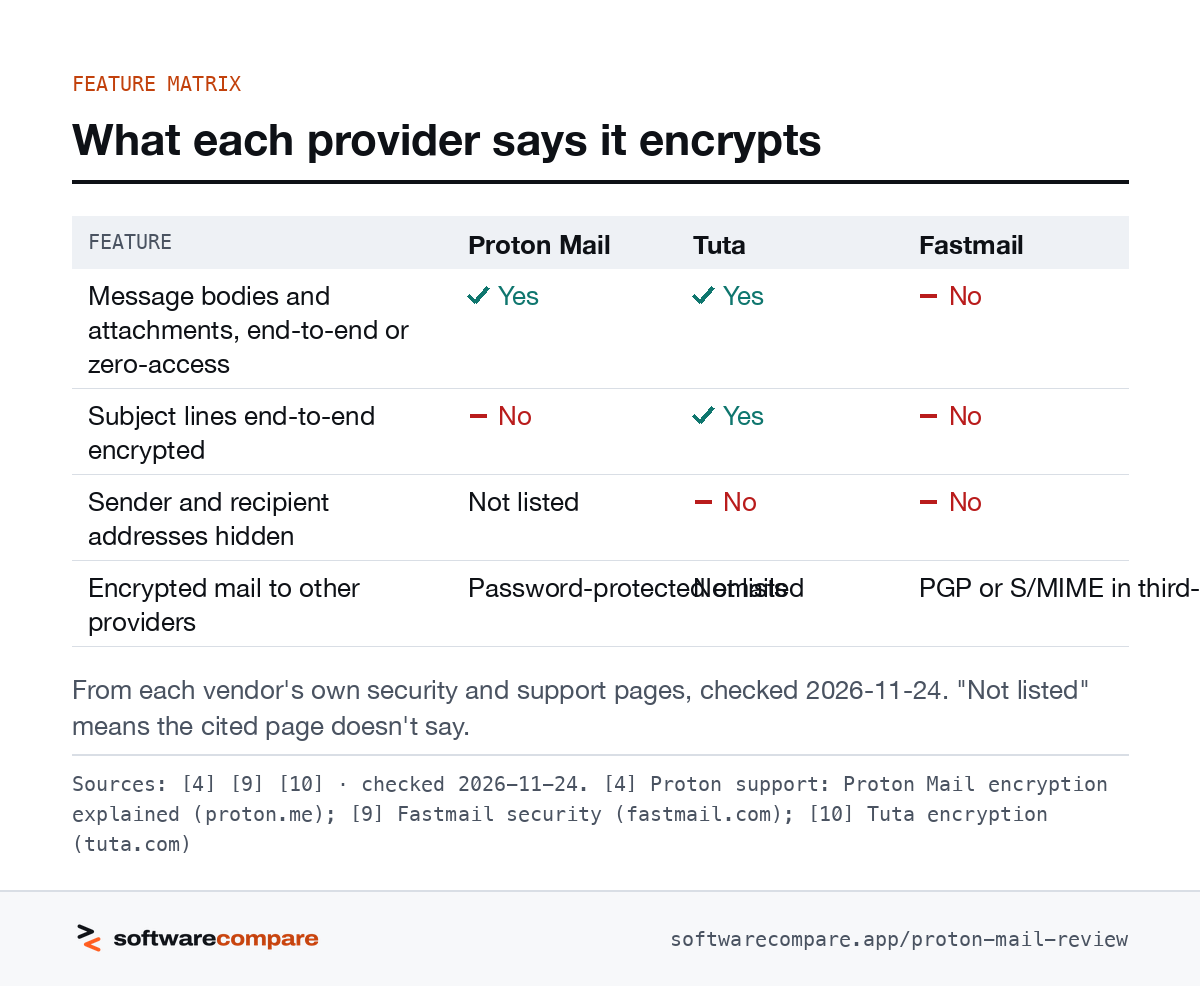
Subject lines are the gap. Proton states that they are not end-to-end encrypted, which it says keeps Proton Mail compatible with OpenPGP standards4. The page does not address sender, recipient or timestamp metadata.
To send an encrypted message to someone outside Proton, you have two options. You can use password-protected emails, which are on every plan including Free1, or the recipient can use PGP with your exported public key4. You can also ask them to reply inside a password-protected thread4.
Tuta goes further on subject lines. It says it encrypts emails “including subject lines and all attachments”, plus whole calendars, contacts, inbox rules and the search index10. Tuta also states that sender and recipient addresses and send dates stay unencrypted because routing needs them10. Fastmail takes a different route entirely: it encrypts data at rest and in transit with TLS 1.3, and says it doesn’t offer end-to-end encryption in its own apps9.
| Feature | Proton Mail | Tuta | Fastmail |
|---|---|---|---|
| Message bodies and attachments, end-to-end or zero-access | Yes | Yes | No |
| Subject lines end-to-end encrypted | No | Yes | No |
| Sender and recipient addresses hidden | Not listed | No | No |
| Encrypted mail to other providers | Password-protected emails | Not listed | PGP or S/MIME in third-party apps |
From each vendor’s own security and support pages, checked 2026-11-24. “Not listed” means the cited page doesn’t say.
Sources: [4] [9] [10] · checked 2026-11-24Download image
Security extras around the inbox
Beyond encryption, Proton’s security page lists5:
- Open-source apps and code that it says has been independently audited by third-party experts. The page does not name the auditors.
- Swiss jurisdiction, with Proton saying it only responds to official requests from Swiss authorities, and its own servers at several locations in Switzerland.
- Two-factor authentication on all accounts, with support for YubiKey and other U2F or FIDO2 keys.
- PhishGuard, which flags spoofed sender addresses, plus link confirmation and SPF, DKIM and DMARC checks.
- Proton Sentinel, an account protection program for high-risk users, monitored around the clock by Proton’s threat detection platform and analysts.
On business plans, Sentinel comes with Workspace Standard and Premium and is missing from Mail Essentials2.
Using Proton Mail with Outlook, Apple Mail or Thunderbird
Because Proton encrypts mail on your device, a normal IMAP client can’t talk to it directly. Proton Mail Bridge fills that gap: it runs in the background on your computer and encrypts and decrypts mail for clients such as Outlook, Apple Mail and Thunderbird6. Bridge is only available on a paid plan that includes Proton Mail6.
If your team lives in Outlook, that rules out the free plan as a daily driver. Business plans list SMTP access for external tools and support for Outlook, Thunderbird and Apple Mail in the plan table2.
Moving in from Gmail or Outlook
Proton’s Easy Switch tool imports messages, calendars and contacts7. For Gmail it also keeps an ongoing connection, so new Gmail mail keeps arriving in Proton and you can send from your Gmail address inside Proton Mail7. From Outlook, Yahoo and Apple it imports your existing history7. The pricing page FAQ adds that imported folders and messages are encrypted as they arrive and the import runs in the background1.
Plan your storage before importing. A few years of Gmail can be bigger than the 1 GB Free cap or the 15 GB on Mail Plus and Mail Essentials12.
Proton Mail vs Fastmail and Tuta
| Proton Mail | Fastmail | Tuta | |
|---|---|---|---|
| Free plan | Up to 1 GB, 1 address1 | No; free trial up to 30 days8 | 1 GB, 1 calendar11 |
| Entry paid plan | Mail Plus, $29.88 first year, then $47.88 a year1 | Individual, $60 a year or $6 monthly8 | Revolutionary, 20 GB11 |
| Business seat, yearly | $6.99/user/mo, 15 GB2 | $5/user/mo, 60 GB (Standard)8 | Not checked |
| Custom domains | From Mail Plus1 | Individual and Standard and up8 | 3 on Revolutionary, 10 on Legend11 |
| Stored mail unreadable by provider | Yes, zero-access4 | No end-to-end in its apps9 | Yes, end-to-end10 |
| Subject lines encrypted | No4 | No9 | Yes10 |
Fastmail is the pick when the mailbox itself matters most. Individual gives 60 GB (50 GB for mail, calendar and contacts plus 10 GB of files) for $60 a year, and every plan can be tried free for up to 30 days8. You choose EU or US data residency and can sign in with passkeys9. Its Basic business plan costs $3 per user per month on yearly billing but has 6 GB and no custom domain8.
Tuta is the pick when you want more of the message encrypted, subject lines included10. Its pricing page lists 20 GB, 3 custom domains and 15 extra aliases on Revolutionary, and 500 GB, 10 domains and 30 aliases on Legend11. The base plan prices didn’t appear in the version of the page we read, so we leave them out rather than guess.
Who should pay for Proton Mail
- Stay on Proton Free for a private second address you check now and then, or to test the apps1.
- Pay for Mail Plus if Proton becomes your main inbox and you want your own domain, unlimited folders or Bridge for a desktop client16.
- Pay for Proton Unlimited if you need 500 GB, 3 custom domains or unlimited aliases1.
- Pick Mail Essentials for a small company that needs shared domains, catch-all and forwarding, and fits in 15 GB per person2.
- Pick Workspace Standard before November 30, 2026 if you want 1 TB per seat and Sentinel, knowing it renews at $14.99 per user per month23.
- Pick Tuta if encrypted subject lines are a requirement10.
- Pick Fastmail if you want a large standard mailbox at a lower seat price and don’t need provider-blind storage89.
Proton also makes a password manager, which we compare in Proton Pass vs 1Password. Read our editorial policy for how we pick and rank tools.
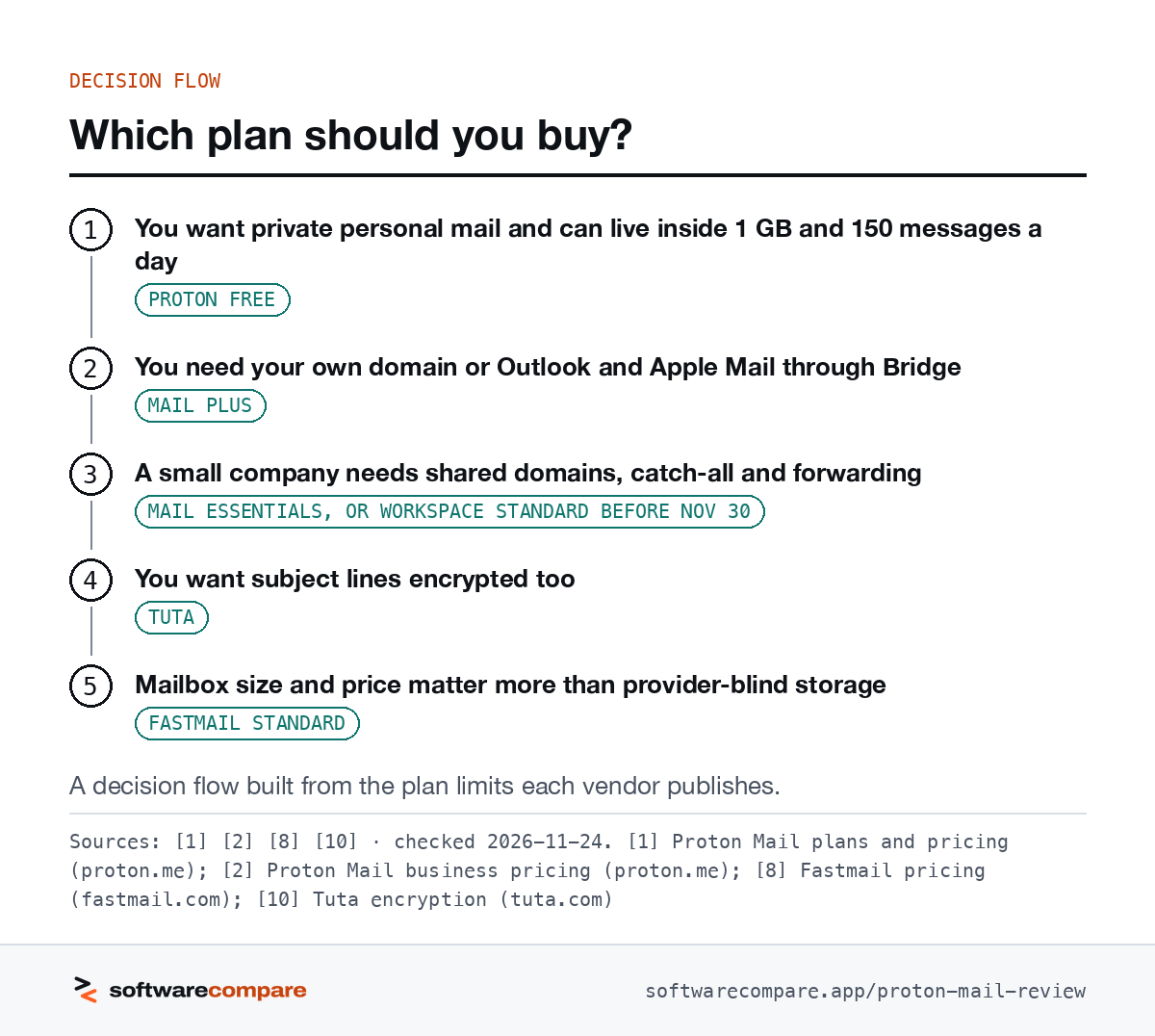
- You want private personal mail and can live inside 1 GB and 150 messages a dayProton Free
- You need your own domain or Outlook and Apple Mail through BridgeMail Plus
- A small company needs shared domains, catch-all and forwardingMail Essentials, or Workspace Standard before Nov 30
- You want subject lines encrypted tooTuta
- Mailbox size and price matter more than provider-blind storageFastmail Standard
A decision flow built from the plan limits each vendor publishes.
Sources: [1] [2] [8] [10] · checked 2026-11-24Download image
Plans
Plans and prices
Proton Mail
Free
Free
checked 2026-11-24
- 500 MB, up to 1 GB after the setup checklist
- 1 address
- 150 messages a day
- 3 folders and 3 labels
Mail Plus
$2.49/mo on a 12-month plan ($29.88 first year)
Renews at $47.88 every 12 months · checked 2026-11-24
- 15 GB storage
- 10 addresses
- 1 custom domain
- Unlimited folders, labels and messages
Proton Unlimited
$6.49/mo on a 12-month plan ($77.88 first year)
Renews at $119.88 every 12 months · checked 2026-11-24
- 500 GB storage
- 15 addresses
- 3 custom domains
- Unlimited hide-my-email aliases
Mail Essentials
$6.99/user/mo billed yearly ($83.88)
checked 2026-11-24
- 15 GB per user
- 10 addresses per user
- 3 custom domains
- Catch-all, forwarding, SMTP access
Workspace Standard
$8.99/user/mo first year (regular $14.99)
40% offer for new users ends Nov 30, 2026 · checked 2026-11-24
- 1 TB per user
- 20 addresses per user
- 15 custom domains
- Email groups and Proton Sentinel
Strengths and limits
Strengths and limits
Proton Mail
Visit Proton Mail (opens in a new tab)
Strengths
- Inbox contents use zero-access encryption, and mail between Proton users is end-to-end encrypted
- Password-protected emails reach people on other providers, on every plan including Free
- Open-source apps, Swiss jurisdiction and servers in Switzerland
- Paid plans add custom domains, Bridge for desktop clients and unlimited folders
Limits
- Subject lines are not end-to-end encrypted
- Free plan caps you at 1 GB, 150 messages a day, 3 folders and 3 labels
- Bridge, needed for Outlook or Apple Mail on personal plans, requires a paid plan
- Business mailboxes on Mail Essentials hold 15 GB per user
Fastmail
Visit Fastmail (opens in a new tab)
Strengths
- 60 GB per user on Standard at $5 per user per month on yearly billing
- Choice of EU or US data residency
- Passkeys and two-step verification
- Free trial of up to 30 days
Limits
- No end-to-end encryption in its own apps; PGP or S/MIME needs a third-party client
Strengths
- Encrypts subject lines, attachments, calendars, contacts and the search index
- Paid plans add custom domains and extra aliases
Limits
- Sender, recipient addresses and dates stay unencrypted for routing
- Free plan has 1 GB, one calendar and no custom domain
FAQ
Questions people ask
Is Proton Mail free?
Yes. Proton Free starts with 500 MB of mail storage, which rises to 1 GB once you finish the Get started checklist. It includes one address, 150 messages a day, 3 folders, 3 labels and 10 hide-my-email aliases1.
How much is Proton Mail Plus?
On the 12-month plan, Mail Plus shows $2.49 a month, billed $29.88 for the first 12 months, then $47.88 every 12 months after that. The page lists $4.99 as the monthly price1.
Can Proton read my email?
Proton says inbox messages and attachments use zero-access encryption and that nobody else can access them, including Proton. Subject lines are the exception: they are not end-to-end encrypted, to stay compatible with OpenPGP4.
Can I use Proton Mail with Outlook or Apple Mail?
Does Proton Mail support custom domains?
Is Proton Mail better than Fastmail?
For privacy, Proton encrypts stored mail so it says it can’t read it4, while Fastmail says it doesn’t offer end-to-end encryption in its own apps9. For mailbox size per dollar on a business seat, Fastmail Standard gives 60 GB at $5 per user per month on yearly billing8, against 15 GB at $6.99 on Proton Mail Essentials2.
Sources
Sources
Small numbers in the text, like 1, point here. Each source shows the date we last checked it.
- 1Proton Mail plans and pricingproton.me
- 2Proton Mail business pricingproton.me
- 3Proton for Business plansproton.me
- 4Proton support: Proton Mail encryption explainedproton.me
- 5Proton Mail security featuresproton.me
- 6Proton Mail Bridgeproton.me
- 7Proton Easy Switchproton.me
- 8Fastmail pricingfastmail.com
- 9Fastmail securityfastmail.com
- 10Tuta encryptiontuta.com
- 11Tuta pricingtuta.com
Updated . See something out of date? Tell us and we will check it against the vendor's page.